Texas Law · Live Case Demos · Property Code Ch. 92
You get a case. The research takes two hours. What if it took five minutes?
The draft you write from scratch takes an hour. You have your templates, so it takes thirty minutes? What if the template came back filled in one minute, checked against the case file and the law, with every claim citing the exact section it stands on? That's what this is: an assistant that reads the case, knows which law matters, and does the work you'd rather hand to someone else. Below are two complete runs on the same subchapter of the Property Code. One representing a tenant suing over a withheld security deposit, one defending a landlord against a treble-damages claim. Same law, opposite sides.
Case 1 · Plaintiff side
The tenant's case: a deposit that never came back
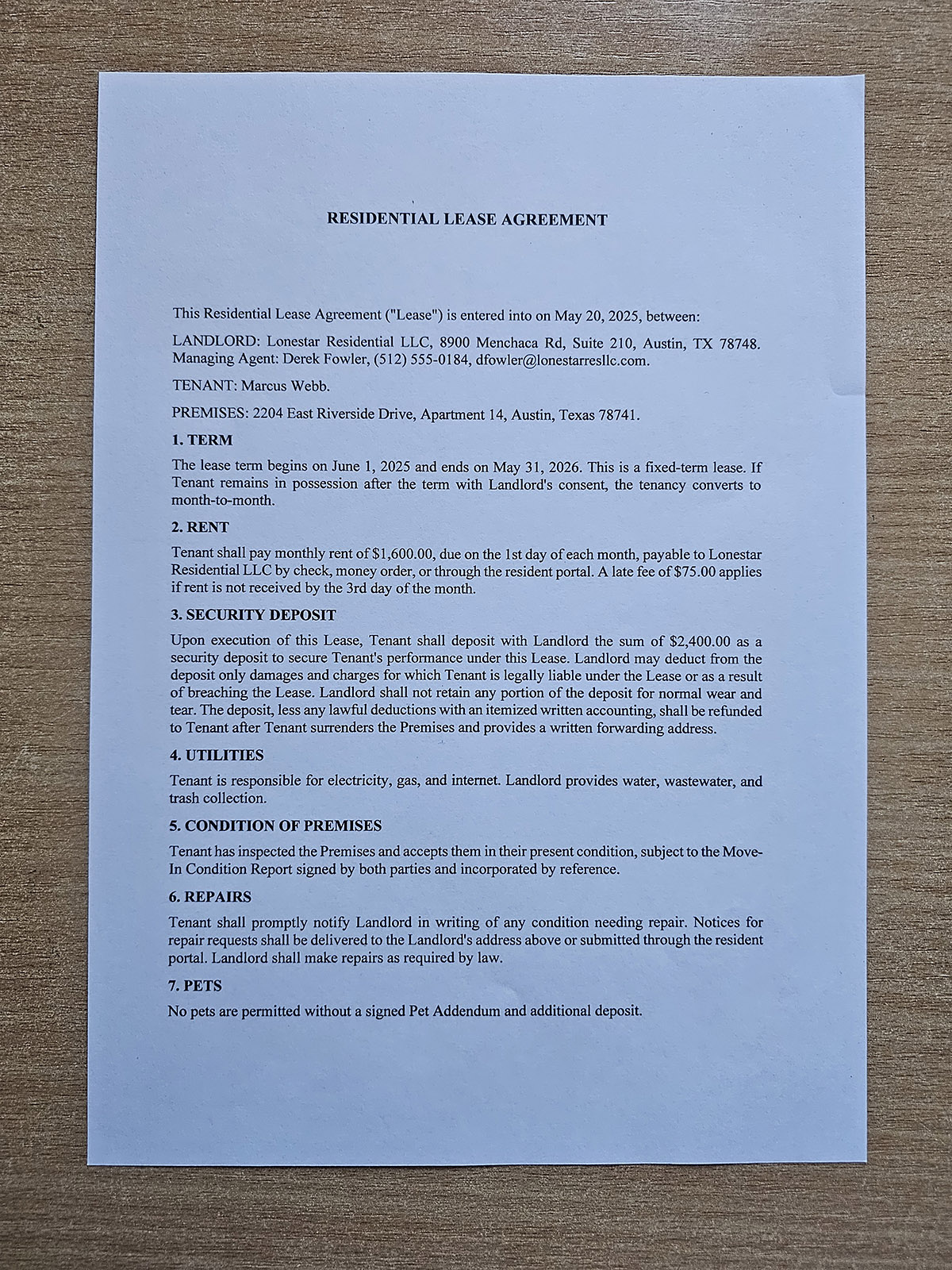
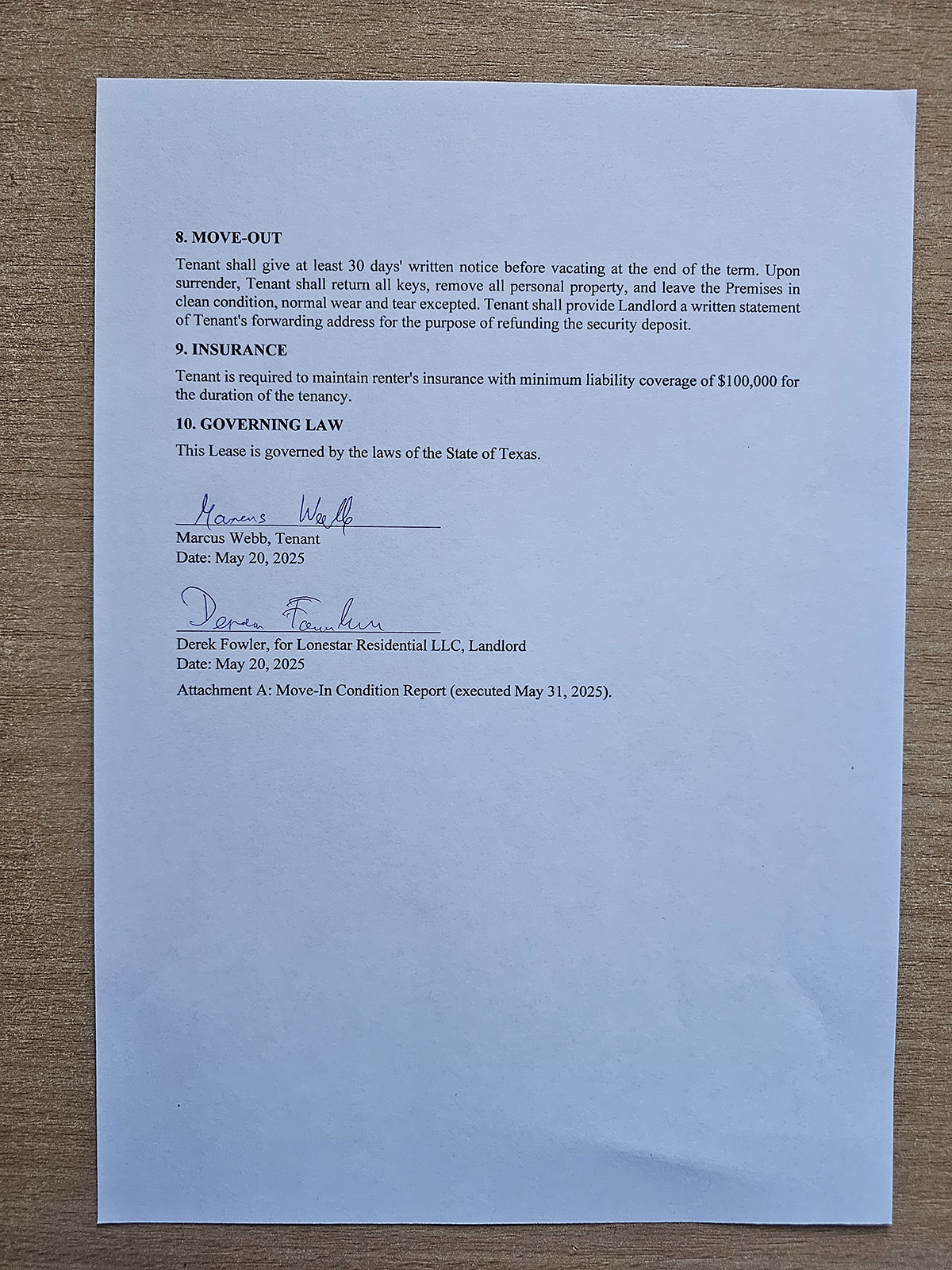
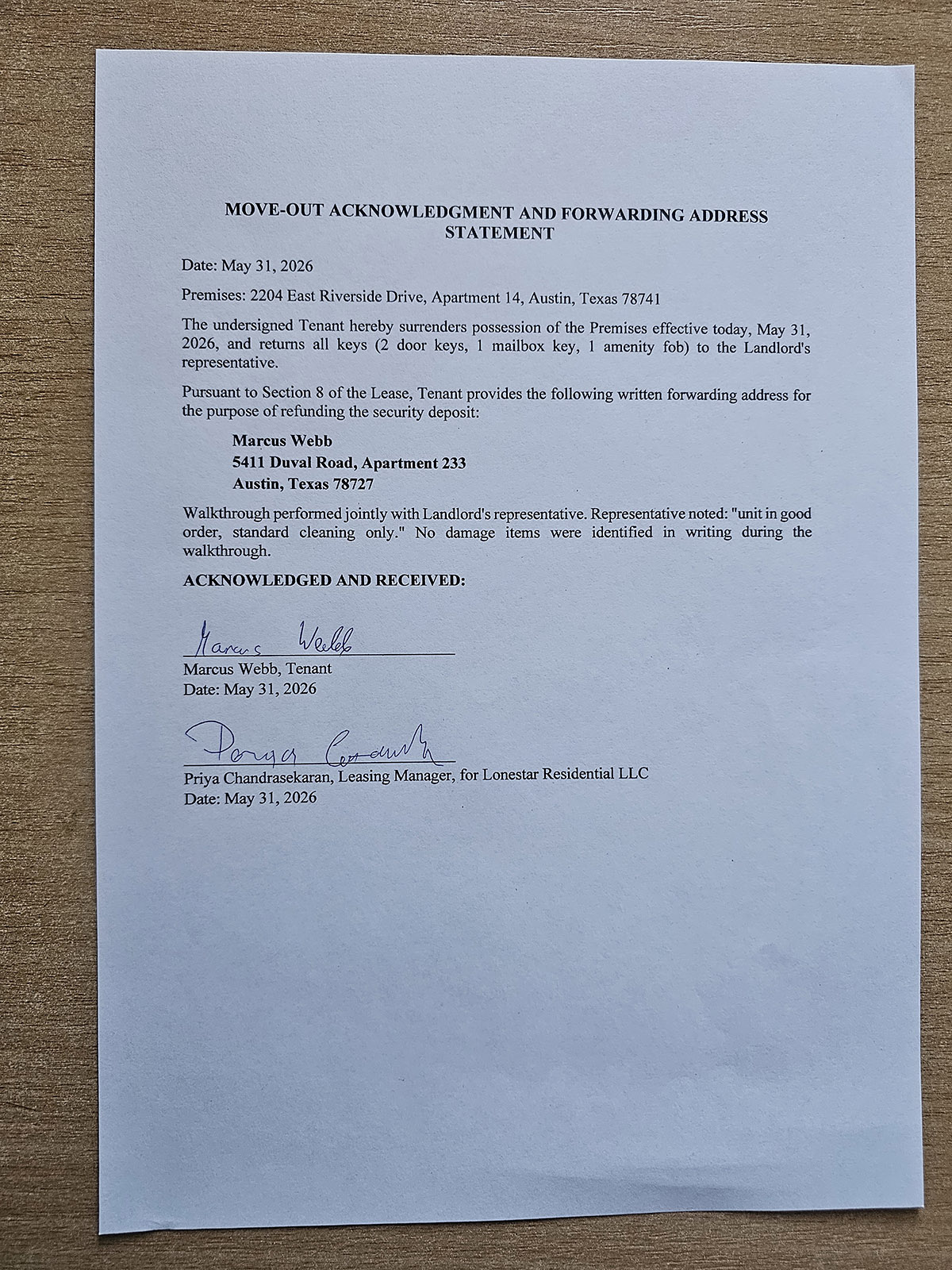
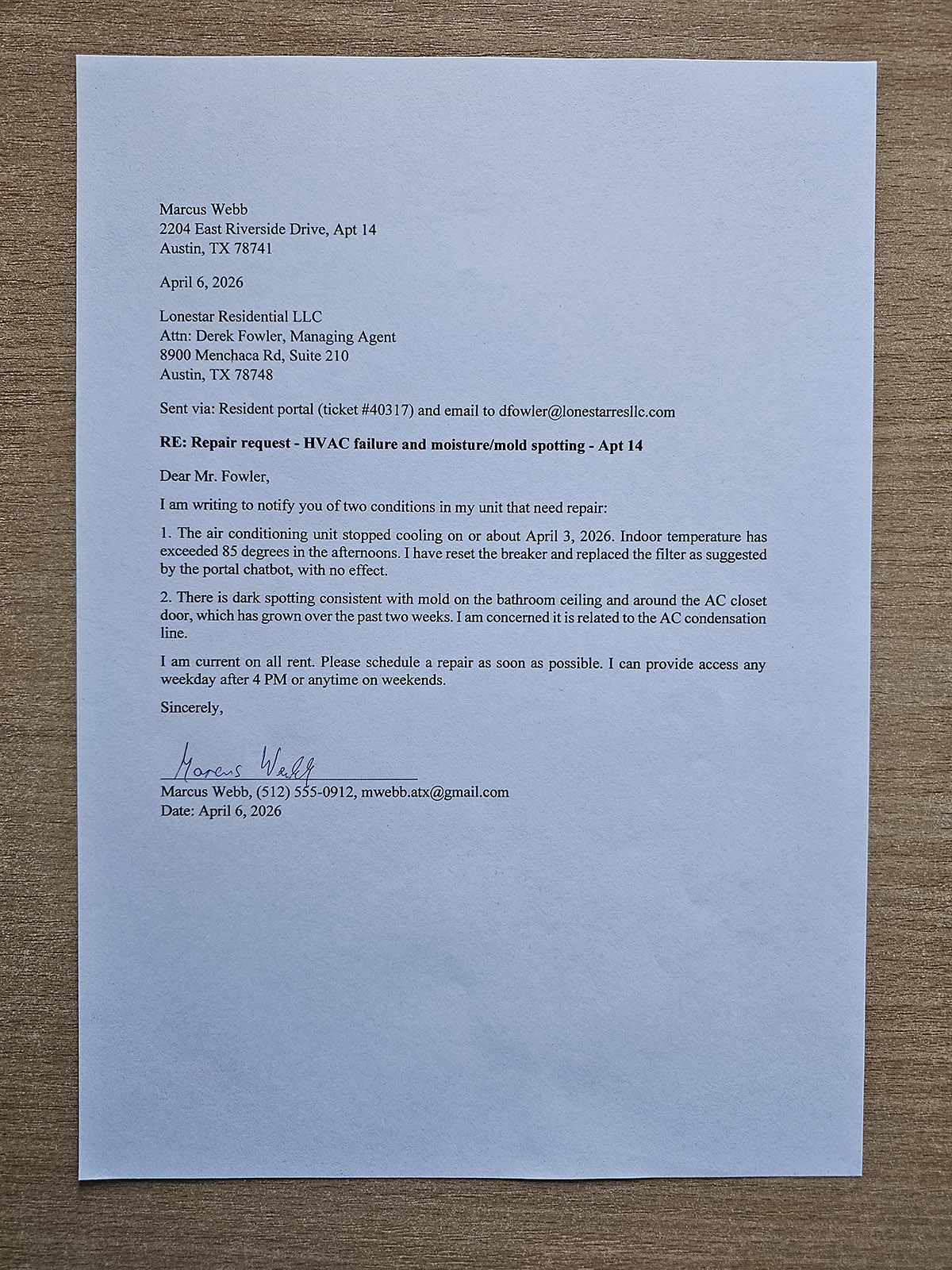
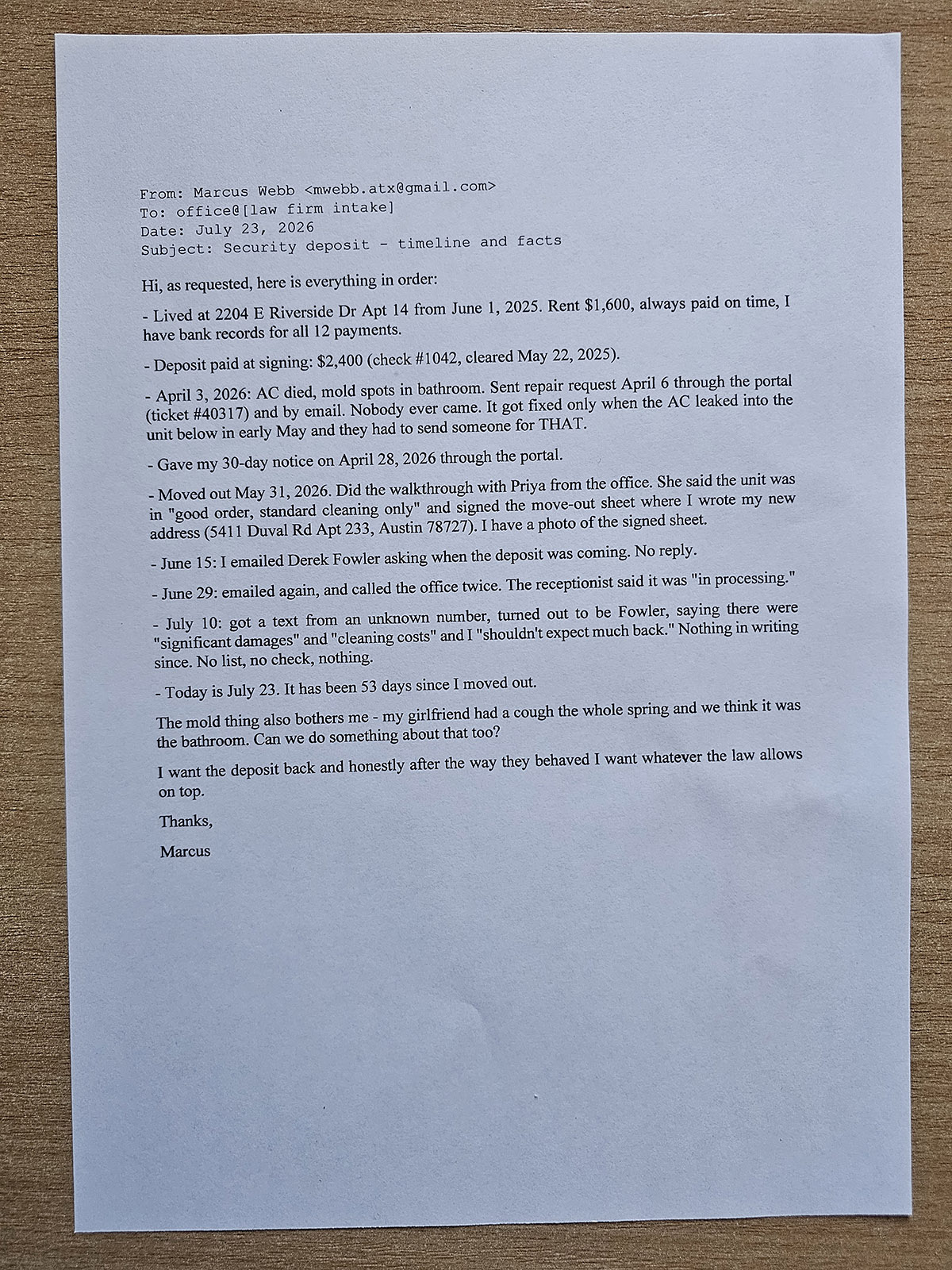
Marcus Webb moved out, gave his forwarding address in writing, and got nothing for 53 days. No refund, no itemized list, just a text saying he "shouldn't expect much back." His file: the lease, the signed move-out sheet, a repair request from April, and his own timeline email. All the documents used as input were uploaded as phone photos. No scanner, no clean PDFs; court files are messy, and the system reads them anyway.
Two prompts: "where do we stand, and is the repair issue worth pursuing?" and "draft the demand letter."
Watch this case run▶
Real session, real system. It answers in whatever language you ask in.
The analysis: "Where do we stand on the deposit?"▶
review the Marcus Webb case. Where do we stand on the security deposit, what are we entitled to claim, and is the repair issue worth pursuing?
Loaded tools · used texas integration · read 5 case documents
Marcus Webb — Case Status MemoWhere we stand on the deposit
Timeline is clean and well-documented:
• Lease: $2,400 deposit, signed 5/20/25, term 6/1/25–5/31/26, $1,600/mo rent.
• Move-out: 5/31/26, joint walkthrough, leasing manager noted in writing "unit in good order, standard cleaning only" — no damage items listed.
• Forwarding address: given in writing that same day, on the move-out sheet itself. This satisfies §92.107 — the 30-day clock is running and there's no "we never got your address" defense available to Lonestar.
• Deadline: §92.103(a) requires refund by the 30th day after surrender → deadline was June 30, 2026.
• Today: 53 days out, zero written accounting, zero refund. The only communication is an unsolicited July 10 text claiming vague "damages" and "cleaning costs."
This is about as strong a deposit case as you'll see:
• §92.109(d): failure to either return the deposit or provide a written itemized accounting within 30 days creates a presumption of bad faith.
• §92.109(c): the burden shifts to the landlord to prove any retention was reasonable — and there is no documentation, given the walkthrough sheet affirmatively states no damage.
• §92.109(b): because no written itemization was ever provided, Lonestar has forfeited any right to withhold a portion of the deposit or sue Marcus for damages to the unit at all.
What we're entitled to claim
Under §92.109(a), bad-faith retention entitles the tenant to: $100 statutory penalty, plus 3× the amount wrongfully withheld (the full $2,400, since no lawful deduction has been documented or is even legally available anymore) → $7,200, plus reasonable attorney's fees. Realistically we're looking at north of $7,300 before fees. Worth sending a demand letter citing the §92.109 bad-faith presumption before filing.
The repair/mold issue — worth pursuing, but as leverage rather than a standalone claim
The facts are sympathetic (HVAC out for a month in Texas summer, visible mold, ignored until it caused property damage downstairs), but there's a real notice defect:
• Marcus sent one written notice (portal + email, April 6) — not by certified or trackable mail.
• §92.056(b)(3) requires either that the first notice be sent by trackable mail, or that a subsequent written notice follow after a reasonable time. Neither happened — no second letter was ever sent.
• Without satisfying that element, the judicial remedies under §92.0563 are vulnerable to a defense. He's also already moved out, so termination and rent-abatement remedies are moot.
Recommendation: don't plead this as a standalone repair cause of action given the notice gap — but it's excellent supporting evidence for the deposit claim: it undermines any "damages" defense, shows a pattern of neglect, and is useful leverage in settlement.
Suggested next step: a demand letter to Lonestar citing §92.103, §92.104 and §92.109, laying out the $7,300 exposure, before filing suit.
The drafting step: the demand letter, done▶
yes, draft demand letter
Drafted · saved to case file as document [12]
Drafted the formal demand on firm letterhead: certified mail + email to the managing agent, full statutory chain — the 30-day duty under §92.103(a), the missing itemization under §92.104(c), the bad-faith presumption under §92.109(d) with the burden on the landlord under §92.109(c), and the forfeiture under §92.109(b) — demanding $7,300.00 within fourteen days, with the HVAC/mold history noted as context and all related claims reserved.
Attorney and firm name are left as marked placeholders rather than invented. Saved into the case file, so the next session picks it up from there.
The other side: defending a landlord against the same statute
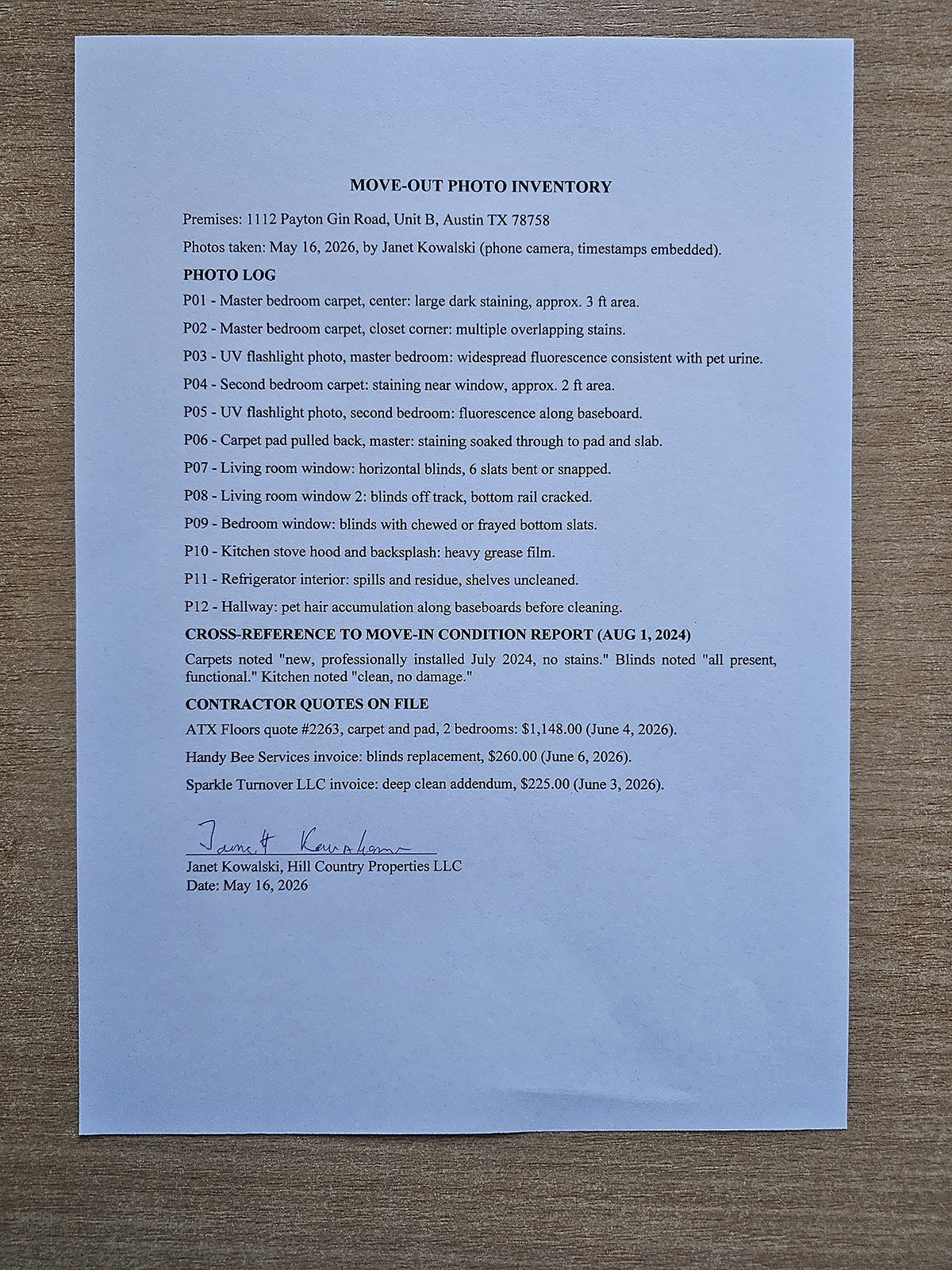
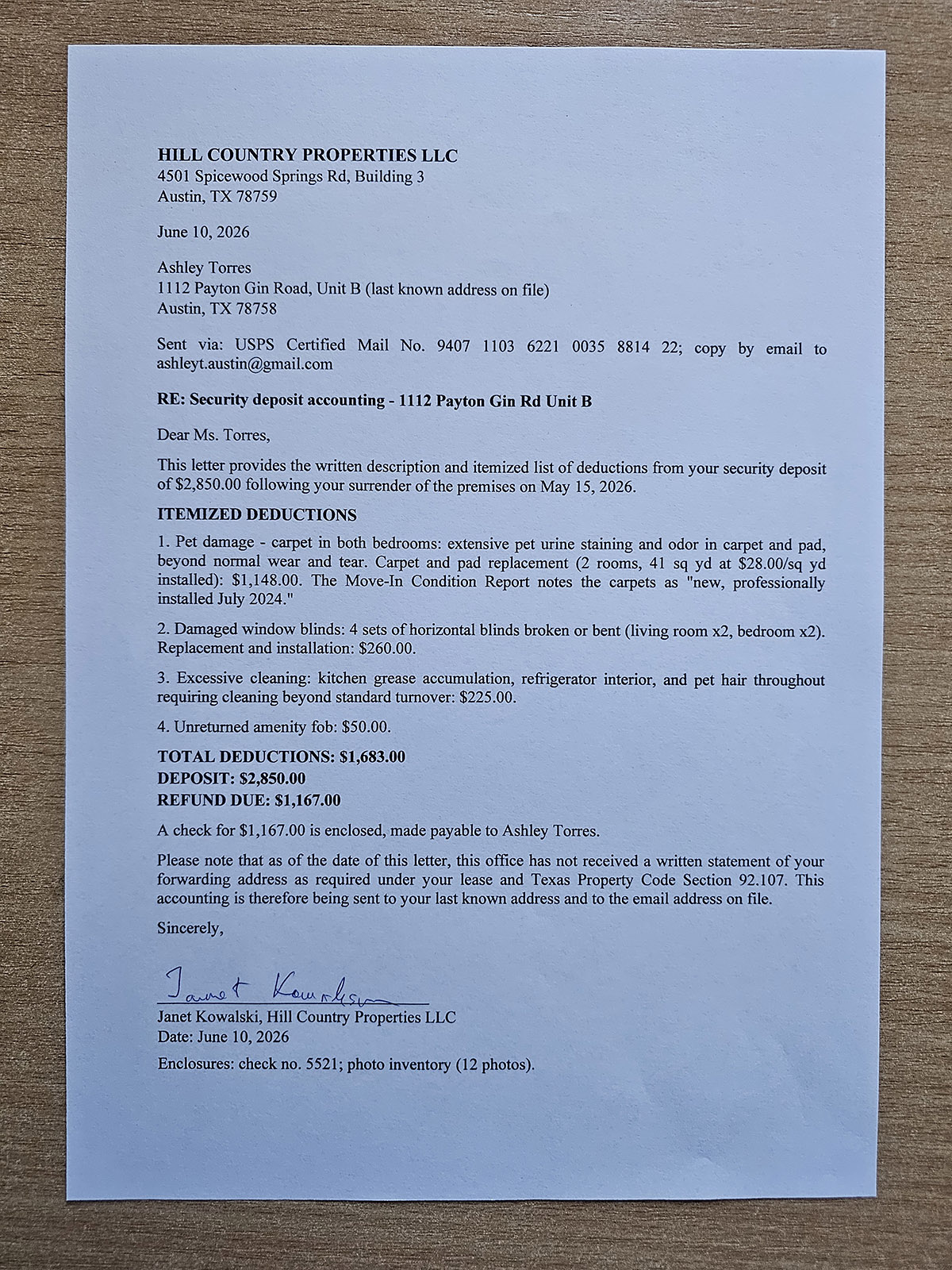
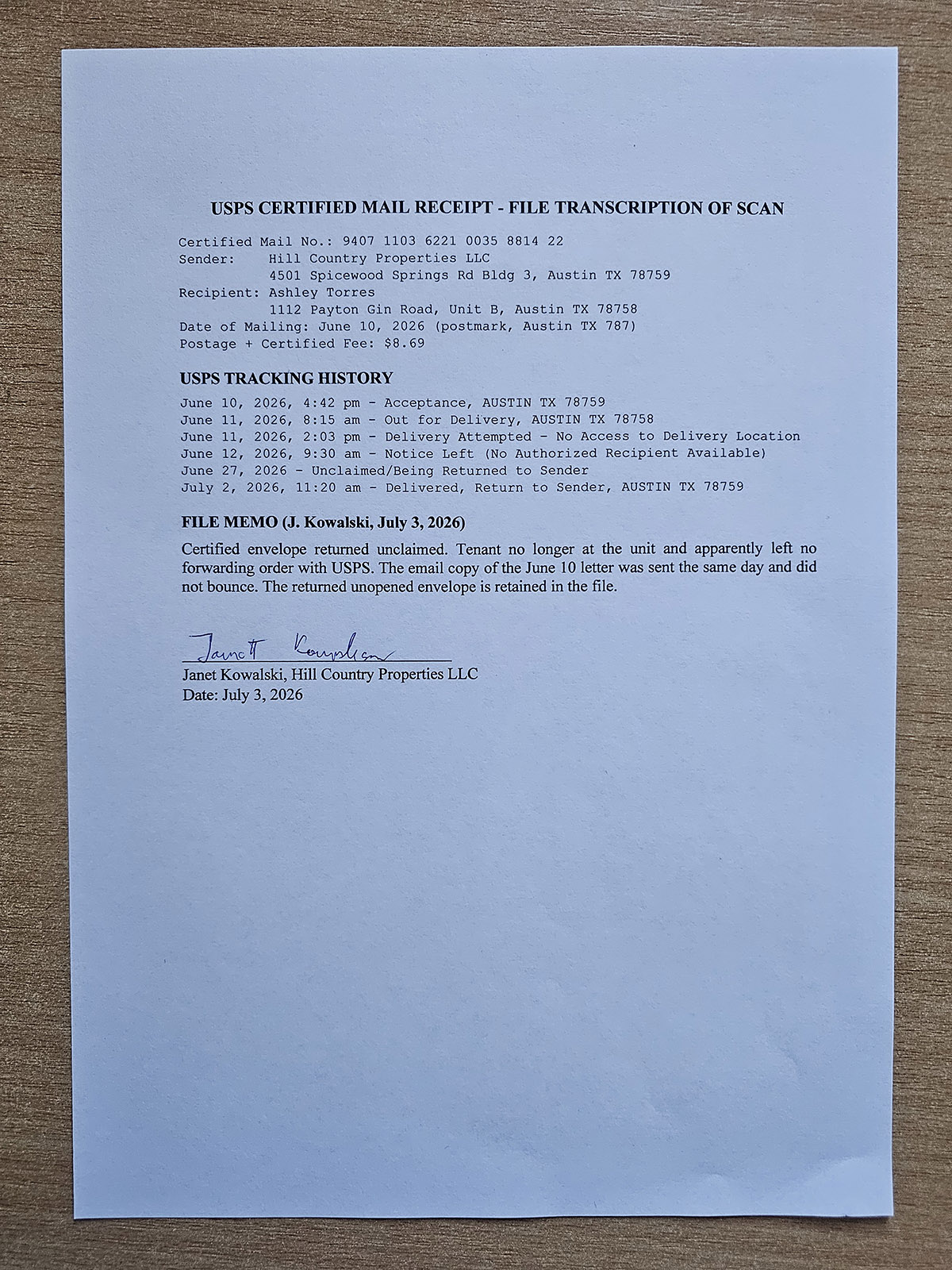
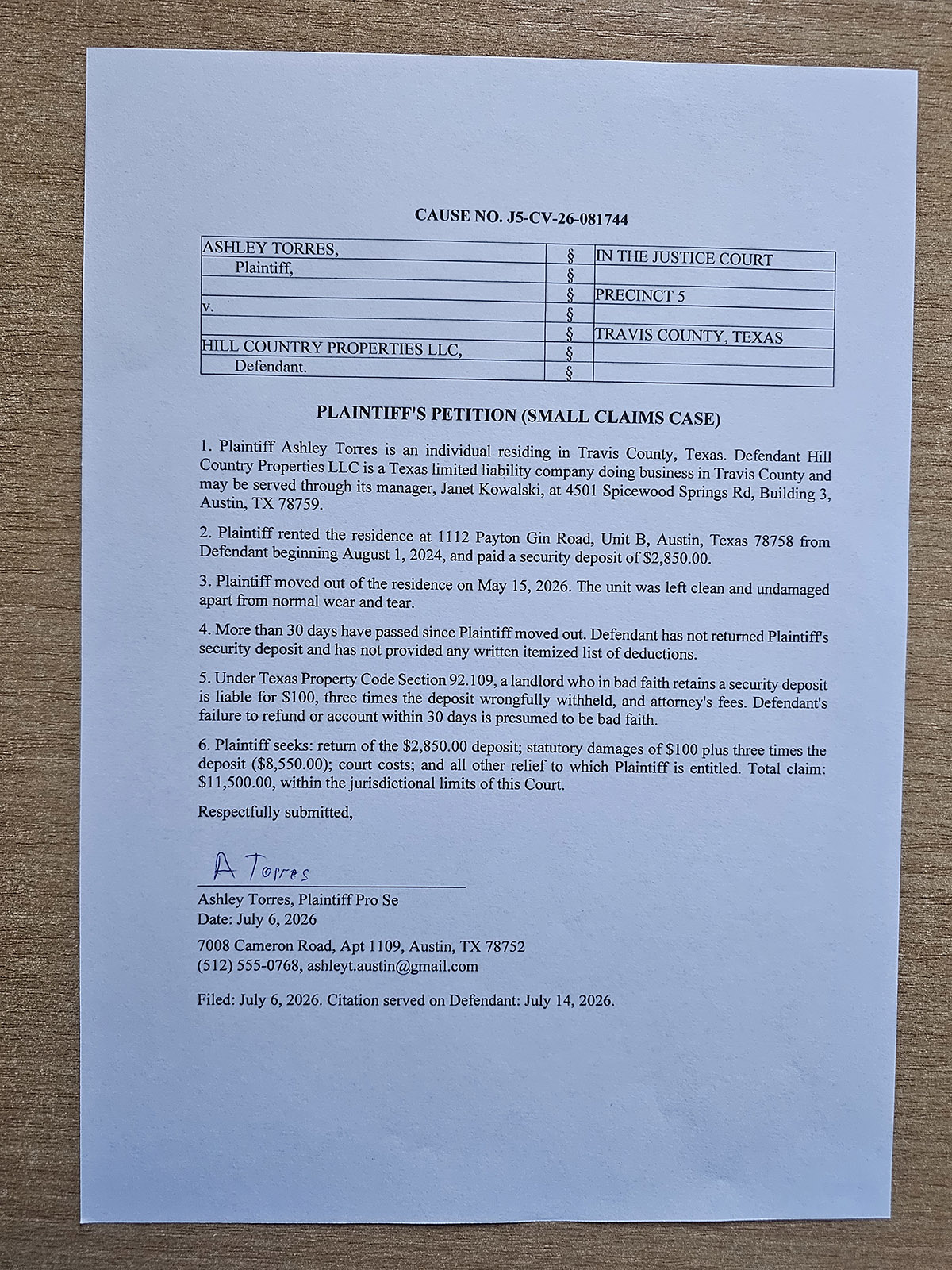
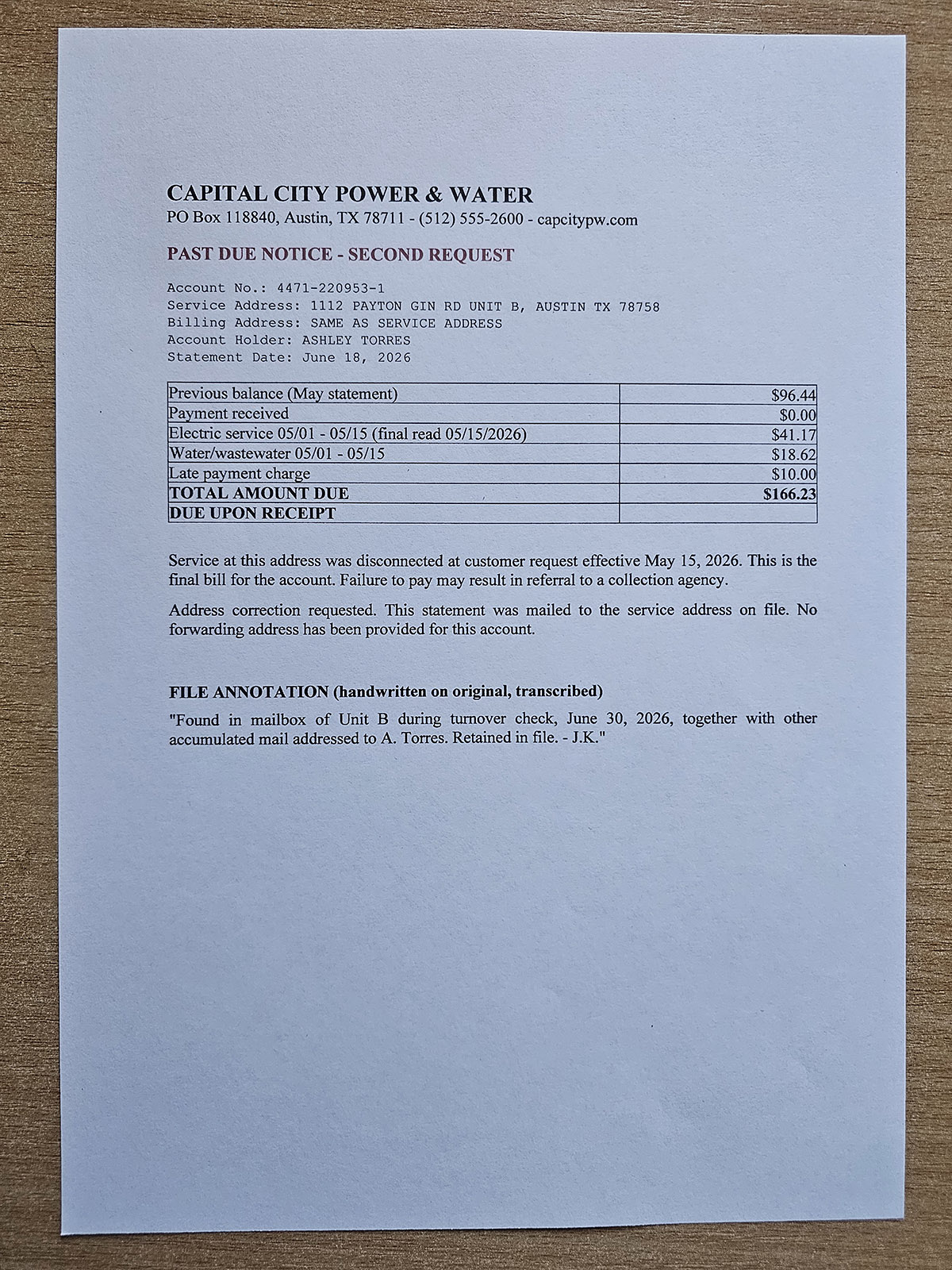
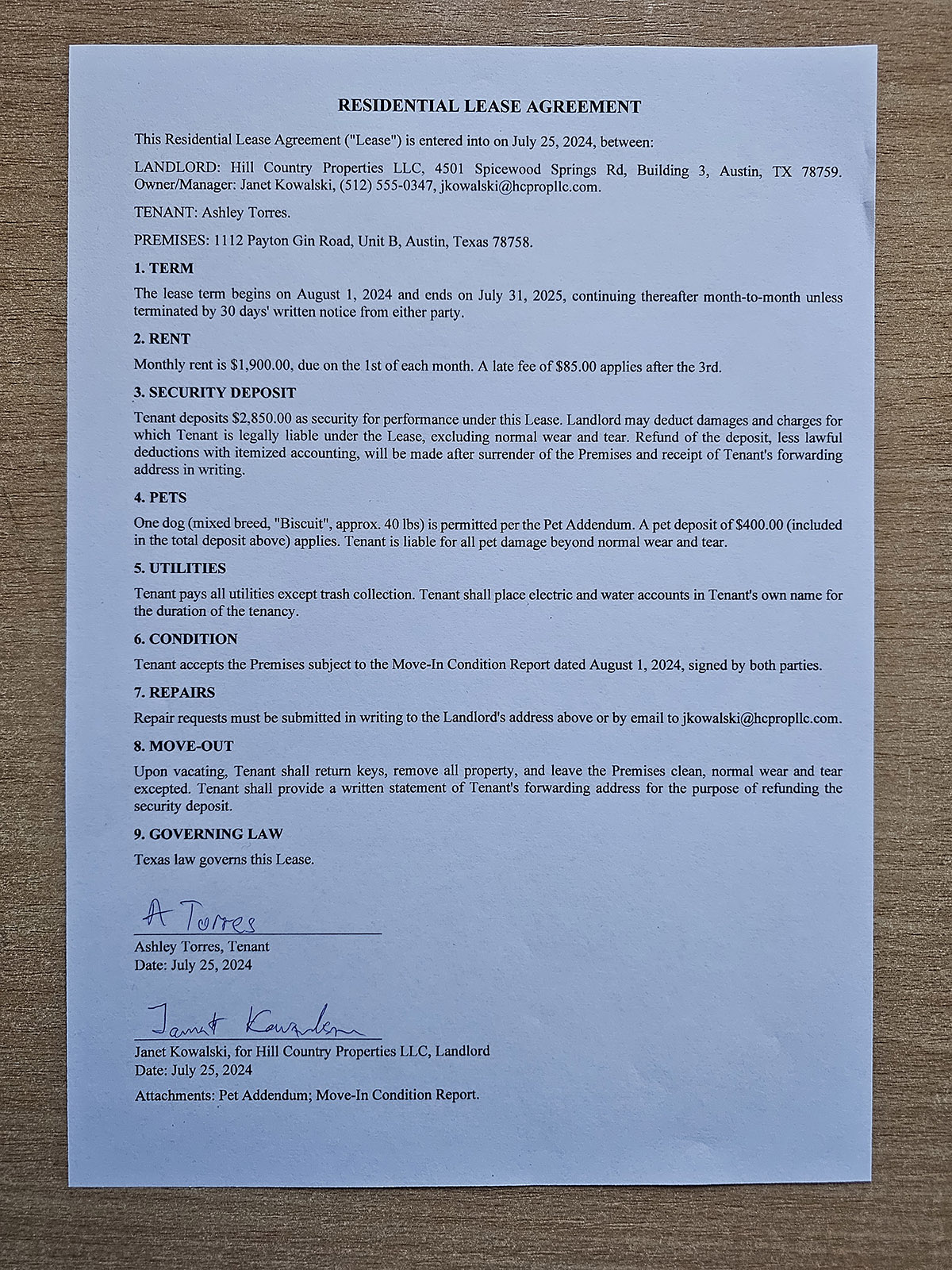
Hill Country Properties is sued in Travis County Justice Court by an ex-tenant demanding $11,500 in treble damages under the exact statute from Case 1. Her petition says no itemized list was ever provided. The firm's file says otherwise: an itemized accounting mailed on day 26 with a refund check, the certified-mail receipt showing it came back unclaimed, a photo inventory benchmarked against the move-in report, and a past-due utility bill found in the unit's own mailbox, still arriving there because no forwarding address was ever left anywhere. All uploaded as phone photos.
Two prompts: "assess the petition against our file — will her treble damages claim survive?" and "draft our answer for the JP court."
Watch this case run▶
Real session, real system. The assistant has no "side" built in; it reads the file it is given.
The assessment: "Will the treble damages claim survive?"▶
we represent Hill Country Properties in the Torres suit. Assess the petition against our file and outline our defense — is her treble damages claim going to survive?
Loaded tools · used texas integration · read 6 case documents
This one's good news for our side.
File vs. petition — the discrepancy
The petition alleges the unit was "left clean and undamaged" and that Hill Country "has not returned the deposit and has not provided any written itemized list of deductions" — and builds the entire §92.109 treble-damages theory on that single factual claim. Our file directly contradicts it:
• "Clean and undamaged" vs. a photo inventory taken the day after move-out — UV-fluorescence photos of pet urine soaked through carpet and pad to the slab, bent and chewed blinds, grease film — cross-referenced against the signed Move-In Condition Report noting carpets "new… no stains."
• "No accounting provided" vs. an itemized accounting letter with a $1,167 refund check, sent by certified mail and email on June 10, 2026 — four days before the 30-day deadline.
• The certified letter came back "unclaimed" only because the tenant moved without a USPS forwarding order and never gave a forwarding address — a fact independently confirmed by the past-due utility bill still arriving at the unit's own mailbox weeks later.
The legal analysis
• §92.109(d)'s bad-faith presumption never attaches. Under §92.1041, an accounting is deemed made if postmarked on or before the 30th day — it was mailed (and separately emailed, no bounce) on day 26. Timely as a matter of law, regardless of what happened in USPS custody afterward.
• The refund obligation was never even triggered. Under §92.107(a), a landlord is not obligated to return a deposit or provide an itemization until the tenant gives a written forwarding address. She never did. Hill Country accounted anyway — which cuts against, not toward, any bad-faith finding.
• The deductions are documented, not "normal wear and tear." Pet urine through to the slab, benchmarked against a signed move-in report showing new carpet, with dated third-party contractor invoices — proper under §92.104, with the burden framework of §92.109(c) well covered.
• She is pro se — she cannot recover attorney's fees she never incurred, which strips a component out of the $11,500 ask regardless of the merits.
Bottom line: the treble-damages theory is unlikely to survive — it depends entirely on a failure to account that the documentary record disproves. The one number actually in play is the $1,167 balance she never received because the letter went unclaimed. Recommended: re-tender that check now, by trackable delivery to the current address on her petition, before any hearing — it moots the "landlord kept my money" narrative and leaves her arguing over individual line items, not treble damages.
The drafting step: the answer for the JP court, done▶
Draft our answer for the JP court
Drafted · saved to case file as document [13]
Drafted the Defendant's Original Answer in proper Texas form — general denial first, then six defenses pleaded without waiver: timely accounting under §92.104(c) and §92.1041; no forwarding address under §92.107(a); the bad-faith presumption rebutted; deductions itemized and supported under §92.104; tender and re-tender of the $1,167 undisputed balance pled in mitigation; and no attorney's fees recoverable by a pro se plaintiff. Prayer, signature block and certificate of service to the plaintiff's current address included.
It also flagged, unprompted: the answer deadline runs from the July 14 service of citation, not the filing date — and Justice Court Rule 500.4 governs who may appear for an entity, so the firm should confirm whether the owner qualifies or counsel appears.
Counsel details are placeholders, not inventions. Saved to the case file.
Every claim cites its section, and the citation is verified against the loaded statute text, not the model's memory. §92.109, §92.107, §92.1041, §92.104: quoted from the Texas Property Code as officially consolidated, current through the 2025 session.
It ran the deadline math both ways. On the plaintiff side it counted 53 days since surrender and invoked the §92.109(d) bad-faith presumption with the exact treble figure. On the defense side, the same statute produced the opposite result: the presumption never triggers when the tenant skipped §92.107's written forwarding-address requirement, and §92.1041's mailbox rule made the day-26 postmark timely as a matter of law.
It caught the trap in its own client's case. The tenant wanted to sue over the mold too. Unprompted, the assistant flagged that §92.056(b) requires a second repair notice, or a first notice by trackable mail, that the client never sent, and advised leading with the clean deposit claim instead of the weak repair claim.
It argues both sides of the same statute. The two cases are mirror images, tenant suing and landlord defending, under the same subchapter of the Property Code. That is the daily reality of practice, and the system has no side baked in; it reads the file it is given.
It doesn't invent. Where the file is silent, counsel details, the certificate-of-service date, the answer deadline, the drafts leave marked placeholders and flag the open item instead of making facts up.
It works your way. Your templates, your structure, your style of argument. The drafts come out the way your filings look, not the way a chatbot writes.
How it works
You talk to Claude, the AI most firms already know. Underneath, it runs on the top tier of Claude models and on the technology the whole AI industry is racing to build right now, working on your cases today. A few steps ahead of what everyone else offers.
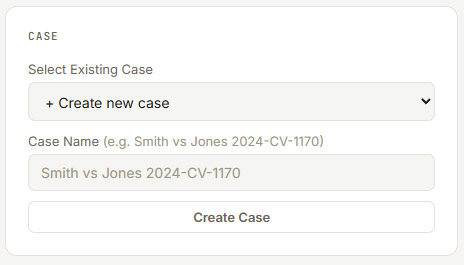
Getting a case in takes five minutes: create the case, link the laws it turns on, upload the documents. Photos, scans, PDFs, Word files, text extracted automatically. All the documents in these demos went in as phone photos.
See the setup, three screenshots▶
Step 1: create the case. One case file per matter. Everything the assistant sees is scoped to this case; nothing leaks between cases or between firms.
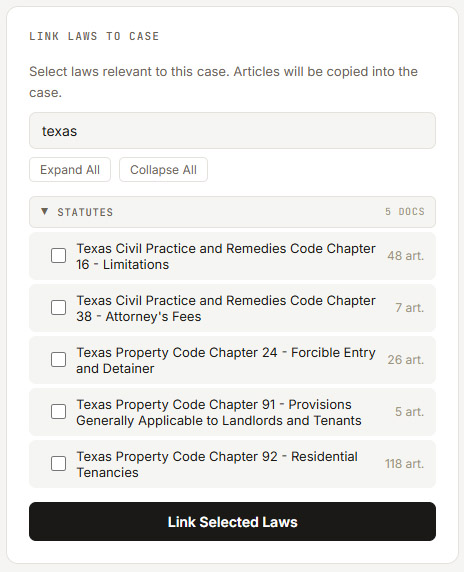
Step 2: link the relevant laws. The statutes the case turns on get linked to it. This focuses the assistant on the right law first, and it can still search the wider library when something outside the linked laws matters.
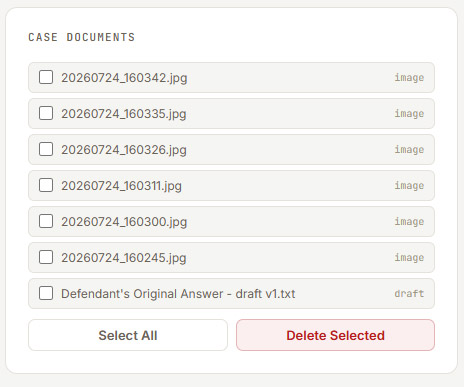
Step 3: upload the documents. Photos, scans, PDFs, Word files. Text is extracted automatically.
From here the lawyer works in the plain Claude chat window, and the runs above show the rest.
Behind the conversation:
01
Each firm gets its own isolated system: own database, own documents, own login. Nothing is shared between firms.
02
Claude connects to it through a secured, authorized channel. The reasoning happens in Claude; the documents and the law never leave the firm's own system.
03
Findings, deadlines and open tasks are saved back to the case file automatically, and the next session picks up exactly where the last one ended. This enables multiple users to work on the same case at the same time.
The whole law, not a summary of it
Texas Property Code Chapter 92 (Residential Tenancies) and Civil Practice & Remedies Code Chapters 16 and 38: loaded section by section from the official consolidated texts, current through the 2025 legislative session, every section individually addressable. The assistant is required to look the law up before making any legal claim. And the corpus is not fixed. New sessions as they pass, more codes, a different jurisdiction: the system uses what your practice needs. Evidence not in English is not a problem either; documents in any language are understood and searchable, and you still work in yours.
Your data
Where your data lives and what gets stored is your call: your own server if you want one, and nothing retained by the AI provider if that's your requirement. Nothing is shared between firms, and nothing from your cases is used for any further training of AI models.
Where this comes from
This demo was not built for this page. It is the same system that runs in production on Serbian law, carrying a full national corpus of 1,590 regulations and 88,000 articles, loaded here with Texas law instead. Different corpus, different language, same system. That is the design.