What makes this interesting
Back in the days of my naive youth, when I worked support trenches, I could tell it was Monday just by looking at a bunch of emails with the subject "WHERE IS MY MONEY" or some variation of it. That lesson (trauma) taught me that sometimes the real signal comes from humans rather than dashboards - an angry email lands before any monitoring graph admits something's wrong. The interesting part wasn't proposing "add AI here" - it was figuring out where a model actually earns its keep without becoming the thing that approves a wire transfer unsupervised, or the thing that replies to those angry emails in the same tone. Every agent below ends in a human decision, not an automated one. That wasn't a nice-to-have, it was the whole design constraint, and it's the difference between something a team will actually run in production and a slide someone nods at once.
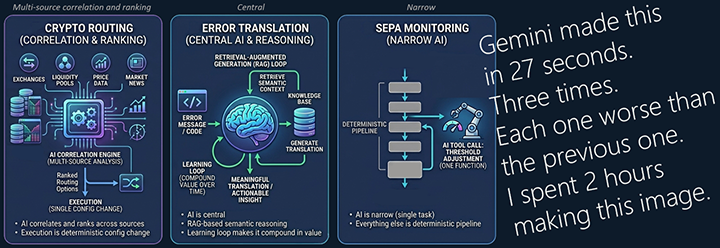
What I expanded it into
Only one of the three got built end-to-end, on purpose. The Sentiment-Based SEPA Monitor has the clearest signal and the smallest blast radius if it's wrong - tightening a monitoring threshold is reversible. The other two stayed concepts: the Crypto Gateway Health Monitor and the Semantic Error Translator are real problems, but doing them properly needs live provider relationships and a fix library that doesn't exist yet outside this write-up. That's the right order regardless - start with the piece that proves value on real data, and let the data earn the rest of the build.
Read whichever one interests you. SEPA has the full build. The other two have the reasoning without the implementation - which is sometimes the more honest version of "done."